Hi,welcome To Login Ehang Electronics Technology Limited.!
- Login Register Collection
- |
- |


Home> Industry Information> Euv Extremely Violet Is Very Difficult! Tsmc Was First Exposed To 5nm: The Frequency Was Only 15%;
Form: laoyaoba.com 2018/5/14 Browse:6645 Keywords: EUV TSMC 5nm
Intel 10nm technology is still struggling, TSI and Samsung have begun to produce 7Nm, the next step is 5nm, and TSI has also recently opened some of the key indicators of 5nm, which seems not to be very optimistic.
Next year, the second generation 7Nm process of TSMC will try to use the EVU ultra violet photolithography system for the first time at some non critical levels. The process node is upgraded from CLN7FF to CLN7FF+, which is claimed to increase the transistor density by 20%, and the power consumption can be reduced by 10% at the same density and frequency.
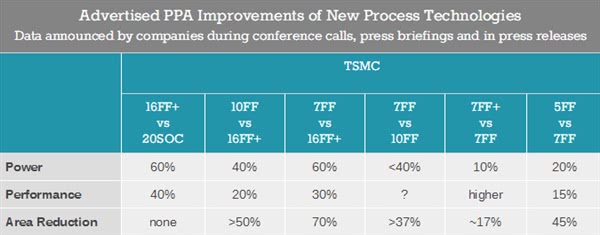
5nm (CLN5) will continue to use the Holland ASML Twinscan NXE: 3400 EUV photolithography system to expand the use of EUV, and the density of the first 7Nm transistor can be increased by 80% (compared to the second generation by 50%).
It looks very fierce, but the actual frequency can bring the increase of only 15%, while the same density and frequency can reduce the power consumption of 20%, compared with the second generation 7Nm upgrade is more limited.
But TSMC also offers an option called "extremely low threshold voltage" (ELTV), which is called to increase the frequency increase to 25%, but does not explain how it is done.
The process has evolved, but the promotion is becoming more and more limited, enough to show the rapid increase in the difficulty and complexity of the semiconductor technology. Of course, it does not exclude that TM has been too willful in the naming of the technology in the past few years, not as old as Intel.
Such a limited promotion, I do not know whether we can attract customers to follow up, after all, we must give full consideration to the cost. The good news is the new technology of TM, all of us are "flocking", for example, 7Nm will have more than 50 chips in the end of this year, covering various fields from high performance to embedded.
At present, the base IP of TSMC EUV 7Nm process has completed chip verification, but the key modules of embedded FPGA, HBM2, GDDR5 and other key modules will be completed by the end of this year or early next year. 5nm will complete the 0.5 version in July this year, and a large number of IP modules, such as PCI-E 4, DDR4, and USB 3.1, are to wait until 2019.
In terms of equipment, TSI will open a new wafer plant Fab 8 for 5nm and introduce a number of new photolithography machines. However, the average daily power of EUV photolithography is only 145W, and some can last several weeks to achieve 250W. It is not enough to be fully invested in business. It is expected to be able to reach 300W later this year, and further improvement is needed.
There is also the problem of EUV photolithography mask material. At present, the penetration rate of extreme ultraviolet light is only 83%, which will exceed 90% next year. Fast science and technology